

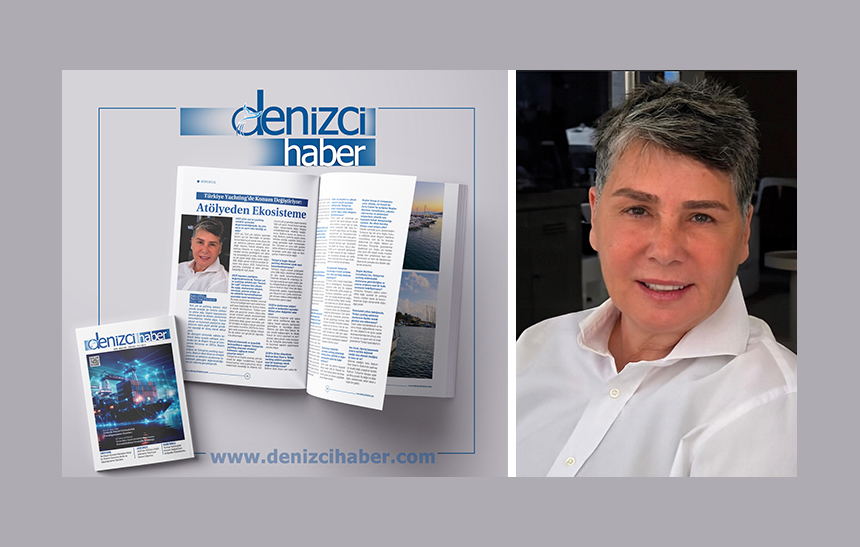
Turkey is Shifting Its Position in Yachting: From Workshop to Ecosystem
The Turkish yacht and yachting sector witnessed a strategic turning point in 2025. This period, which went beyond production capacity, highlighted the importance of international positioning, brand perception, legal infrastructure, and corporate structure.
The Turkish yacht and yachting sector reached a strategic turning point in 2025. This period, which went beyond production capacity, drew attention as a process in which international positioning, brand perception, legal infrastructure, and corporate structure were brought to the forefront more strongly.
One of the names approaching the sector with a holistic perspective during this transformation process is Begüm Doğulu, Founder and CEO of Begüm Group of Companies.
We conducted an interview with Doğulu, where we discussed Turkey's yachting vision, the strategic significance of the Bodrum Boat Show, and the sector's future in international competition.
When you assess 2025 in terms of the yacht and yachting sector, what do you think was the most distinctive feature of this year?
For me, 2025 stands out as a year of awareness and repositioning for the Turkish yacht sector. This year made it much clearer that the sector must compete not only with its production power but also with its vision, legal infrastructure, international communication, and brand language. Countries that create the right environment of trust in the right place and with the right language are now coming to the fore, not just those that build good yachts. 2025 was a threshold year when Turkey faced this reality and began to take steps.
Throughout 2025, your assessments emphasized that it was an “important threshold” for Turkey's yacht and yachting sector. How would you define this threshold in terms of international competition, legislation, investment environment, or the institutionalization of the sector?
I define this threshold as a turning point where international competition, legislation, and institutionalization began to be discussed simultaneously. Turkey has been a very strong manufacturing country for many years; however, establishing a truly lasting presence in the global yachting ecosystem is only possible by not just manufacturing, but also by providing trust, transparency, and the right legal framework. By 2025, it became clear that these issues could no longer be postponed. This was a real period of maturation for the sector.
Despite global economic and geopolitical uncertainties, what are the key factors enabling Turkey to remain competitive in the yachting sector?
Turkey's greatest advantage is its ability to offer multi-layered value. Our geographical location, skilled workforce, the flexibility of our shipyards, and our lifestyle, which perfectly reflects Mediterranean culture, remain very strong. However, we can remain competitive when we tell the right story in the right locations. Bodrum is the most concrete example of this. Bodrum is one of the rare centers that can bring together production and lifestyle, technology and aesthetics, yachting and culture. Having the world's longest coastline and the historical fabric, nature, and climate conditions in every port along the coastline is an exceptional value.
How would you position Turkey within the global yachting ecosystem today?
I position Turkey today as a country with high potential but still waiting to be properly understood. We are among the world leaders in production; however, we are not as strong in terms of perception. This is precisely where we need strong brands like Bodrum and events like the Bodrum Boat Show, held in the right location. Because the global yachting world invests not only in yachts but also in destinations.
What notable changes have occurred in 2025 in terms of the international customer profile and expectations?
International customers now look much more closely not only at the technical specifications of the yacht but also at its flag, legal structure, operational safety, and the reputation of the country where it is located. Questions such as “Where will I moor this yacht?” and “What happens if I encounter legal problems in this country?” are being asked more loudly. This necessitates the strengthening of consultancy, legal, and corporate structures in Turkey.
How do you assess the Bodrum Boat Show, held for the first time in 2025, as a starting point for the Turkish yachting sector?
I see the Bodrum Boat Show not just as an exhibition, but as a very strong statement of intent. It was the clearest way of saying, “I am also present on the Turkish yachting scene, and I am saying this from Bodrum.” Although it was held for the first time, thanks to the chosen location, it spoke from a very accurate place in terms of international perception.
How do you think the fair's structure, open to international participation, contributed to Turkey's global yachting image?
International participation transformed this fair from a local exhibition into a global showcase. However, what was truly important was that this showcase was established in Bodrum. Because Bodrum is already a familiar, reliable, and desirable destination for foreign investors and yacht owners. This directly increased the credibility of the fair.
Despite being in its first year, what did you find to be the strongest aspects of the Bodrum Boat Show?
Its strongest aspect was that it was held in the right place. Bodrum is a city that perfectly matches the spirit of yachting. Participants didn't just see yachts; they experienced Bodrum's lifestyle, the atmosphere at the marina, and the destination's potential. This creates an impact that no indoor exhibition can match.
In your opinion, in which areas does this organization need to improve in order to secure a permanent place in the international yacht show calendar in the coming years?
It is important to further strengthen international promotion, invite foreign brokers and investors in a more systematic way, and enrich the content with legal and financial panels. The Bodrum Boat Show should become a platform where not only yachts are shared, but also knowledge, trust, and vision. Events such as chef competitions should be held at international fairs, with foreign brokers serving as judges. This would make the fair more attractive and provide a great opportunity to showcase the talents and skills of Turkish chefs to foreign brokers.
When you look at superyacht projects and high-end yachting, what do you think is Turkey's current perception on an international scale?
Turkey is known as a very strong country in superyacht production. However, there is still a need for a more institutional perception in project management, legal structure, and after-sales processes. To strengthen this perception, it is essential that our shipyards become more visible on the international stage and stand behind their responsibilities more. Reliability is a very valuable issue. Furthermore, unfortunately, our country currently lacks the infrastructure to host and refurbish superyachts. If we want to have a say in the international arena, we must urgently complete our infrastructure deficiencies first.
In your opinion, in which areas are the most fundamental challenges Turkey faces in this segment concentrated?
The biggest challenge is legal predictability and standardization. International customers want clarity. Therefore, proper consultancy, transparent processes, and compliance with international standards are critical. Turkish yachting needs to be properly explained to our government. If the sector wants to be part of the international platform, it will not resist the government's efforts to achieve those standards and legalize the sector. The Turkish Yacht Code must be issued, the Agency Regulation must be implemented immediately, and refit companies must definitely be licensed by the state. No one should be able to get together and do this serious work without any professional certification; unfortunately, when mistakes are made, it is our country that pays the price.
Why are legal certainty, transparency, and proper consultancy so crucial in the yachting sector for international customers?
Because investing in a superyacht is as much an emotional decision as it is a serious financial one. Without trust, there is no investment. Legal certainty determines a country's true reputation in yachting.
Under the umbrella of the Begüm Group of Companies, Begüm Maritime Consultancy, which you opened at Zorlu Center on November 22, offers comprehensive legal consulting services to foreign investors and potential clients. How did the need to establish this office arise?
For years, I have observed the following in the sector: there is interest in Turkey, but there is a lack of proper legal guidance. Begüm Maritime Consultancy was born precisely to fill this gap. To be able to tell foreign investors that they are safe in Turkey. Our goal is to draw the right roadmap, create happy customers with a competent team, and contribute to the reputation of our company, our sector, and our state, even if only in part.
How do you aim for Begüm Maritime Consultancy to contribute to Turkey's international credibility and investment environment in the yachting sector?
Our goal is to position Turkey not only as a manufacturing country but also as a reliable yachting law center. The right consultancy creates the right perception.
Looking ahead to the coming years, where would you like to see Turkey's yachting sector on an international scale?
I envision Turkey becoming one of the Mediterranean's strongest yachting destinations, with marinas capable of accommodating superyachts and providing winter storage facilities; a country that serves as an example in terms of production, law, and lifestyle.
Finally, is there anything else you would like to mention or add to this interview?
I would like to add that holding the Bodrum Boat Show in Bodrum is not a coincidence, but a strategic choice. Bodrum is Turkey's yachting face to the world. The more we embrace this value, the further we will advance as an industry.